Reflections on Why I Stopped Practicing Medicine, For Now
I’ve done my talk therapy via laptop-propped-up-on-shoebox ever since COVID. It wasn’t long ago — February 2025, perhaps? — that my therapist casually asked me a seemingly simple, therapy-ish question: What gives your life meaning?
Before going any further, you should know that I’m a certified chatterbox emergency physician. I’ve made thousands of hours of small talk while suturing. I like to ask old people what’s been the biggest change in their lifetime. I know how to say “pain” and “thank you” in at least seven languages. I am not, generally speaking, someone who struggles to find a few words of banter.
But sitting there in my tiny home office over Zoom, I didn’t know how to answer the question. I remember asking her, puzzled, “What do you mean by meaning?” The question genuinely did not compute. When I searched for “meaning” in my head, it was just a void. Not “I know what meaning is, and I don’t have any,” but just a lack of any definition whatsoever. It was like she’d asked the question in a foreign language.
That scared me, because I knew what it implied. I knew there should have been an answer there, either an obvious immediate one, or something that would come to me with deep introspect. Or hell, even a superficial lie would have been better than stunned silence. But instead I just stared at the screen with nothing, at all, to say.
I thought about that question for months afterward. Somewhere along the way in my life, I think I’d confused two ideas that sound almost identical: medicine is meaningful and medicine gives my life meaning. Those aren’t quite the same thing. I’d been keeping my clinical practice alive through COVID mostly on coffee, inertia, and fumes, and on my deeply held belief that this is who I am. This is what I do. I didn’t dare ask myself if it felt worthwhile. And if I’m honest, it didn’t feel like it was a question I was even allowed to ponder, as a Doctor.
Becoming a Physician
The problem with asking whether “this is who I am” is that medicine had spent essentially my entire adult life making the answer yes.
See, I excel at hoop-jumping, like all of us in medicine. “Physician” or “doctor” has been the through-line of my entire adult life, the organizing principle, the answer to both “what do you do?” and “who are you?” You take the classes, get the grades, take the MCAT, get into medical school, pass the boards, match, survive residency, do fellowship, pass more boards, get the job, work shifts. There is always another hoop, and I was always extremely good at jumping through it.
Hoop-jumping is even, I daresay, a little comforting when you spend your youth learning how to get good at it. There is always a next step, and someone else has already told you what it is. Somewhere along the way, without really noticing, I stopped distinguishing between progressing through medicine and progressing through my life.
And medicine wasn’t just organizing my life. It was changing my brain. Permanently.
Medicine doesn’t just change what you know. Eventually, it changes what you see, and how you experience the world. I hear a croupy cough in the airport and the diagnosis is as instinctual as putting your hands out when you fall. I was at a takeout restaurant a few months ago and, without “turning on my doctor brain,” noticed something was off with the woman behind the counter. Her skin color was just… medically wrong. Very slightly too pale. Two seconds of eye contact and I already had a differential diagnosis in my head. I held my tongue, took my food, and left, carrying a small clinical observation I had absolutely no idea what to do with.
Sometimes that rewiring feels like a superpower. Sometimes I wish I could turn it off.
When my Nana was dying on hospice, while sitting with her surrounded by family, I noticed her breathing pattern change. I knew what that meant. Cheyne-Stokes respirations. The dying process was progressing. There was that little physician voice in my head, whispering, “A-ha: diagnosis: Cheyne-Stokes, Graham.” In that moment, I desperately just wanted to be her grandson, hold her hand, and say goodbye. I wanted to tell the physician voice in my head to fuck off. No such luck. You can’t turn him off. I've tried.
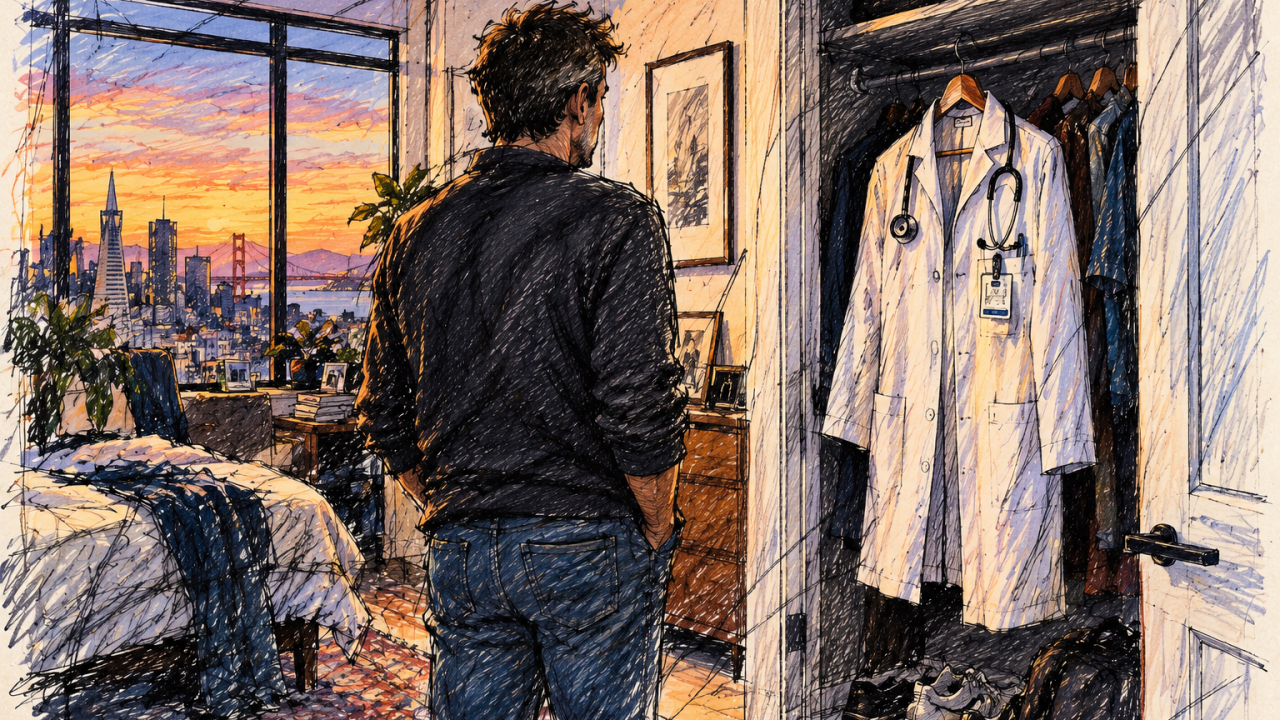
That’s one of the strange things about contemplating leaving clinical medicine: I’m not actually sure it’s even possible to stop being a physician. Sure, I can stop working shifts. Sure, I could remove “emergency physician” from my bio. But I don’t think I can make my brain stop seeing the world this way. For a long time, I think that made the idea of stopping almost nonsensical. If this is who I am, how or what exactly do I quit? I quit... what, being me?
Permission
For a long time, though, there was another reason stopping felt impossible: I didn’t think I was allowed to.
One of the first cracks came in April or May of 2020. A few months into the pandemic, PPE was still rationed and every cough felt like COVID and contagion and an exposure I was forced to bear. I was showing up anyway, as were my colleagues. That’s who we were as emergency physicians.
I remember her well. A woman in Room 19 — let’s call her Darlene — refused to wear a mask. Refused to be tested, even, despite coming to the ER for fever and shortness of breath. Darlene “didn’t believe in that Corona bullshit.” She was in my emergency department asking for help from people who were exposing themselves to something we still barely understood, and she couldn’t be bothered to do something that might make us greatly, marginally, or even symbolically safer.
I also remember being surprised at how Darlene made me feel. Not anger, but sadness. A deep, clarifying sadness. Because somewhere in my head, I'd assumed there was something reciprocal about all of this. I would show up. I would work nights and weekends and holidays. I would accept some amount of risk and sacrifice because caring for other people was important. And in return, there would at least be some basic acknowledgment that my health and safety mattered, too. Society would value what I did. The sacrifice would be worth it.
Standing in that curtained room with Darlene, I asked myself, maybe for the first time: worth what, exactly?
Pots and pans would be banged for us at night, but when it came to COVID, or chronic job stress, or physical assault on healthcare workers, there was always some version of “you signed up for this.” Somewhere in there I realized that no one was going to look out for me simply because I had agreed to spend my career looking out for everyone else. I was going to have to do that myself.
More importantly, I was allowed to do that.
That was something I hadn’t fully given myself permission for before. I’m a doctor. I “have it good.” Other people have it worse. You get what you get and you don’t get upset. Medicine is very good at teaching you that self-sacrifice is virtuous. It is less good at telling you when you’ve sacrificed enough.
The Job Changed, Too
But I don't want to reduce this story to burnout, or COVID, or some lady named Darlene, or even some midlife realization that weekends are nice.
The job changed, too.
One night, a woman came into the ER at 1am on a Friday because a call-center algorithm told her to. She had stabbed index finger with a (clean!) sewing needle while hemming her pants. She needed a tetanus shot — her records showed she was overdue. She had waited four hours for this.
I didn’t have the energy to explain to her the chain of decisions that had produced this moment: the liability culture that makes “go to the ER” the default answer for almost any after-hours concern, the algorithm that flagged her tetanus status without clinical context, the complete absence of any lower-acuity option available to her at 1am on a Friday night. I tried to apologize. I tried to waive her copay.
What that moment crystallized for me was something I’d been absorbing for years without naming it: I had become the last node in a liability-management system. The place the algorithm sends you when it doesn’t know what else to do with you. And when you arrive — after your four-hour wait, for your undetectable, invisibile sewing needle injury at 1am — I'm the one who looks you in the eye and tells you that you didn’t need to be here. That the system failed you. That I’m sorry.
The system doesn’t apologize. So I do, on its behalf. Every shift.
The sewing needle was absurd, but it wasn't unique. Somewhere along the way, the patient in front of me had become only one of the many people I worked for, and the one with the least say in how the system works.
The insurer decides if what doctors prescribe is paid for. The health system sets the appointment times and "throughput targets." Regulators, lawyers, coders, and the quality measure du jour all get a vote on what I did and how I documented it. And how I should spend my time. Some well-meaning committee could decide that one more mandatory click in the EHR would finally make healthcare safe, and by Monday it was part of my job.
Each of them could add something to my shift. None of them ever took anything away. Every new requirement assumes my time is infinite. It isn't. A shift is a fixed number of hours, and every minute someone else claimed came from the same place: the time I had with the person in front of me. Everyone else got a seat at the table where the rules were written. The patient and I mostly met afterward, inside the system those rules produced.
Nobody designed it this way. It’s the accumulated result of thousands of individually usually-reasonable decisions, usually made far away from the moment when someone has to find the minutes to carry them out.
Everyone with power spent my time. The patient is who it was taken from.
I think I knew for years that the trend wasn’t sustainable. I just hadn’t given myself permission to do anything about it. And then, as I wrote about in Part 1, my friend Brian died. His death made “someday” feel considerably less theoretical.
So after years of treating stopping clinical practice as an enormous, irreversible decision, I finally did something much smaller.
I took a break.
The Experiment
Nine months ago, I went on sabbatical. (Thank you, TPMG, for even making that possible.)
I thought I’d miss clinical medicine within six weeks. I was certain of it! I told my chief, “I’ll probably get bored and pick up some weekend shifts after the first month.” I had practiced emergency medicine for 18 years, and for most of that time in the same department. Being the person who ran toward the problem, who found signal in the noise, who stayed useful when everything was falling apart — I assumed that without the shifts, I’d feel the absence like a missing limb.
Instead, I accidentally ran the experiment I'd been afraid to run.
Nine months later now, and I still don’t miss it. I wish I did. I even, weirdly, want to miss it. But if I’m brutally, frighteningly honest? I don’t.
I’ve waited, and checked, and reflected, and my Magic 8-Ball answer keeps coming back the same. I miss the people — desperately, genuinely — the nurses and physicians and techs and consultants I’ve worked alongside for more than a decade, colleagues who became close friends. That absence is real. But the shifts themselves? The overnights, the waiting room, the suturing in the hallway, the apologies for the waits, the banal workups, the constant low-level awareness of twelve other things that need my attention while I’m trying to concentrate on the human being sitting in front of me? I set them down and they never got back up.
I didn’t even know my last shift was my last shift. I thought I was going on a break. I didn’t say goodbye to anyone. I didn’t take a picture or make a speech or stand outside the ambulance bay contemplating the thousands of patients I’d cared for. No potluck-'n'-cake celebration. I just signed out my last patient and left, like every other shift.
There’s something strange about the absence of ceremony for something that took up so much of my life. But maybe that’s right, too? It wasn’t one dramatic moment. It was a long accumulation of moments, each one small, each one absorbed, until the weight became undeniable. And then one day I put it down.
What I notice most now is how quickly not practicing started to feel normal. Regular people have weekends. They have holidays. They make plans for Friday night without wondering whether they’ll be wrecked from a Thursday overnight, or whether they’ll be able to sleep Saturday afternoon because they’re back in the ER Saturday night. I knew this abstractly while I was practicing. Living it is different.
I don’t love admitting that, because it implies something about the weight I was carrying that I didn’t fully acknowledge while I was under it. Buuuut it’s true.
And strangely, saying that out loud is where some of the harder feelings start.
Am I Still a Doctor?
Here’s my nightmare: I'm standing at a conference with you, shaking your hand, seeing "MD" on your name tag, and I wince. I sheepishly mumble, Actually, I stopped practicing last year. I imagine feeling a flash of something uncomfortable in my stomach. Not regret. Probably more like shame. Or maybe just the anticipation of your judgment.
Because medicine is very good at making people feel like leaving is failing. We don’t even talk about it like a normal profession. Medicine is a calling. It’s a vocation. It’s a privilege. We serve. We sacrifice. And I actually believe in a lot of that language, which is precisely what makes it so powerful. If being a physician is not just what you do but part of who you are — even part of what makes you a good person — then deciding to stop can feel like more than a career decision. It can feel like a judgment about your character.
I know exactly what the little voice in my head says about that: I’m a quitter. I couldn’t handle it. I sold out. I broke my end of the bargain.
I’ll admit how I really feel about this: writing this all out right now: eighteen years of practicing medicine does not feel like it’s enough. There’s a weird part of my brain that apparently believes the only acceptable amount of practicing medicine is “until retirement.” Anything short of that feels like I don't “have what it takes” (whatever the hell that means). I think part of me will always wonder whether other physicians see me that way. Part of me sees myself that way.
But I’m starting to understand something more.
Stopping clinical practice didn’t make me stop being a physician. I don’t think I actually know how to do that. Medicine has rewired too much of me. I’ll probably hear croup in airports for the rest of my life. I’ll notice strangers’ skin color and breathing patterns and wonder whether someone's mole looks weird. I’ll probably never be able to sit beside someone I love in a hospital room without some part of my brain eyeing their cardiac monitor. Some of that is a gift. Some of it isn’t. But it’s mine now.
What I stopped doing was practicing clinical medicine. For most of my adult life, I had treated that and being a physician as essentially synonymous.
They’re not.
Meaning
I still think about the question my therapist asked me that day: What gives your life meaning?
I have better answers now. Not the answer, certainly. But answers.
Sometimes I found meaning in the ER. Not in “being a doctor” in some abstract, heroic story arc, and definitely not in clearing the waiting room or getting my charts done. I found it in individual moments: helping someone who was scared, making a clutch diagnosis, figuring out what was wrong, sitting down next to a patient and actually connecting with another human being. Sometimes, patients would even ask me if I'd be their primary care doctor — the biggest compliment an ER doc can get. Those moments were real. They've faded, but they still carry weight.
I’ve also realized I find meaning in things that have nothing to do with practicing medicine. I find it in friends and connections and travel and pets. I find it in writing. I find it in trying to understand something that’s bothering me, putting words around it, and then doing exactly what I’m doing right now: throwing those words out into the world and discovering that someone else has been feeling the exact. same. thing.
Maybe that’s part of what I couldn’t understand when my therapist asked me the question. I had spent so long assuming that meaning came packaged with the identity of “doctor” that I wasn’t really looking for it anywhere else.
Medicine is meaningful. Being a physician has been one of the most meaningful things I’ve ever done, and caring for another human being on one of the worst days of their life is an extraordinary privilege. I will never regret the thousands of people who trusted me to do that, or the person those experiences made me.
But I no longer think something being deeply meaningful obligates you to do it forever.